hplc-py

Stack: Python • SciPy • NumPy • Pandas • Seaborn

hplc-py

High-Performance Liquid Chromatography (HPLC) is a workhorse analytical technique for quantifying chemical mixtures, but extracting accurate measurements from the resulting data often requires tedious manual processing. To streamline this bottleneck, I developed and maintain hplc-py, an open-source Python package that automates peak detection and quantification from chromatography data. The software implements a robust pipeline for baseline correction, peak identification, and fitting that reduces hours of manual labor to minutes of computation. Since its release, hplc-py has seen steady adoption, receiving 300-500 downloads per month and can be easily installed via pip install hplc-py. The package is published in the Journal of Open Source Software and remains actively maintained with community contributions through GitHub.
The Human Impacts Database

Stack: Django • Postgres • Elastic • Bootstrap • VegaLite

The Human Impacts Database

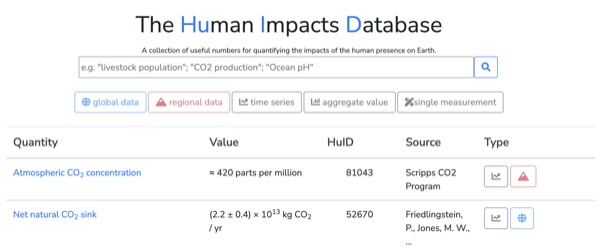
Human activity represents the largest ecological experiment in Earth’s history, yet its planetary-scale consequences remain abstract to many people. To make these impacts quantifiable and accessible, I developed and maintain the Human Impacts Database (anthroponumbers.org) — a web platform that catalogs key measurements revealing humanity’s environmental footprint. The database includes diverse metrics ranging from annual ice-sheet melt volumes and ocean acidification rates to residual plutonium in soils from 1960s nuclear testing and global livestock populations. Built in the spirit of the BioNumbers database for biological data, this resource provides scientists, educators, and the public with authoritative numbers that contextualize human impacts across geological, chemical, and ecological scales. The platform receives several hundred queries per month and continues to grow as new measurements become available.